ADHD Meal Planning: Why Every Planner You've Tried Has Failed You (And What Actually Works)

You've tried the meal planners. Probably more than once.
You downloaded a template, filled it in with the best of intentions, felt briefly and intensely organised — and then by Wednesday it had completely fallen apart. Because you weren't hungry for what you'd planned. Or cooking that specific thing on that specific evening felt genuinely impossible. Or life happened in the way life always does and the whole structure crumbled.
So the planner got abandoned. And maybe you quietly concluded that you're just not a meal planning person. That it works for some people, but not for you. That something is wrong with your follow-through.
Here's what I'd suggest instead: the planner was wrong, not you.
Most meal planning tools were built for a neurotypical brain. They assume consistent energy, reliable appetite prediction, and a smooth path from "plan" to "execution" — none of which describe how ADHD or autistic brains actually work. Until you use a system designed for your brain, you'll keep running into the same wall.
I'm Bogi — a dietitian and AuDHD adult. I've experienced this mismatch personally and professionally. This post breaks down exactly why standard planners fail, and what neurodivergent-friendly ADHD meal planning actually looks like in practice.
What Standard Meal Planning Assumes (That Isn't True for ADHD)
Before we talk about what works, it's worth naming what doesn't — and why.
Standard meal planning advice assumes a particular kind of brain. A brain that can predict what it will want to eat in four days. That has consistent energy across the week. That experiences food as fairly neutral — something to be scheduled and optimised. That can shift from "plan" to "execution" without a significant gap.
For ADHD and autistic brains, several of these assumptions break down.
ADHD brains live heavily in the present.
What you'll want to eat on Thursday is genuinely unknowable on Monday, because your appetite, sensory preferences, and available energy on Thursday depend on what happens between now and then. Planning Thursday's dinner on Monday isn't forward-thinking — it's a guess with a decent chance of being wrong. And when it's wrong, you feel like you failed the plan rather than recognising that the plan failed you.
Autistic food preferences are context-dependent.
Many autistic people find that what they can eat varies significantly based on sensory state, anxiety levels, and what's been demanded of them that day. A "varied" meal plan — something different every night, balanced across food groups — can be a source of stress rather than a feature.
Executive dysfunction creates a gap between plan and action.
Even when you know what you're supposed to make for dinner, getting from knowing to doing requires a sequence of steps — each of which demands executive function. Starting a task, transitioning between tasks, maintaining the sequence of cooking steps: all of these are affected by ADHD.
A plan that doesn't account for this gap isn't a realistic plan for your brain.

The Real Goal of Meal Planning: Fewer Decisions, Not a Tighter Schedule
Here's the reframe that changes everything:
The goal of meal planning is not to create a perfect schedule.
The goal is to reduce the number of decisions you have to make in the moment.
That's it.
When you get home at the end of a draining day, what you have the least of is decision-making capacity. The question "what should I eat tonight?" sounds simple, but it actually involves: assessing your current hunger, checking your sensory state, reviewing what's available, ruling out options that require too much effort, considering timing — and then making a choice. That's a chain of cognitive steps for what most people assume is a five-second question.
A meal plan removes that calculation. You don't decide tonight — you check what's already been decided. Even if the decision you made earlier isn't perfect for right now, having a default to work from is often enough to break the inertia.
The key is designing the plan with flexibility built in from the start.
What ND-Friendly ADHD Meal Planning Actually Looks Like
It doesn't look like "Monday: grilled chicken with roasted vegetables." Here's what it actually looks like:
Flexible options, not fixed meals.
Instead of "salmon on Wednesday," you plan "something protein-heavy that takes under 20 minutes". Or you identify three dinner options you rotate between depending on what feels right that evening. The plan sets constraints, not mandates.
Effort tiers built in.
Acknowledge that your available energy varies. Some evenings you can cook a proper meal. Some evenings pasta and a jar of sauce is the maximum. Some evenings the best you can do requires no cooking at all. A plan that only works on your average-capacity days isn't a functional plan — it's optimistic fiction.
Repeated meals without shame.
If you found something you can reliably make and eat, there is nothing wrong with eating it multiple times a week. Routine and repetition reduce decision fatigue, keep safe foods accessible, and remove the pressure to constantly perform culinary variety. Repetition is a feature, not a failure.
A shorter planning horizon.
Planning a full week of dinners in detail is probably too much. Planning two or three days ahead, or identifying a weekly "anchor" shop and then deciding daily, might suit your brain far better. There is no rule that a meal plan must cover seven days.
Room built in to deviate.
The plan is not a contract. If Wednesday's meal isn't happening because you're exhausted, that's fine. The plan exists to help you, not to generate guilt when life intervenes.
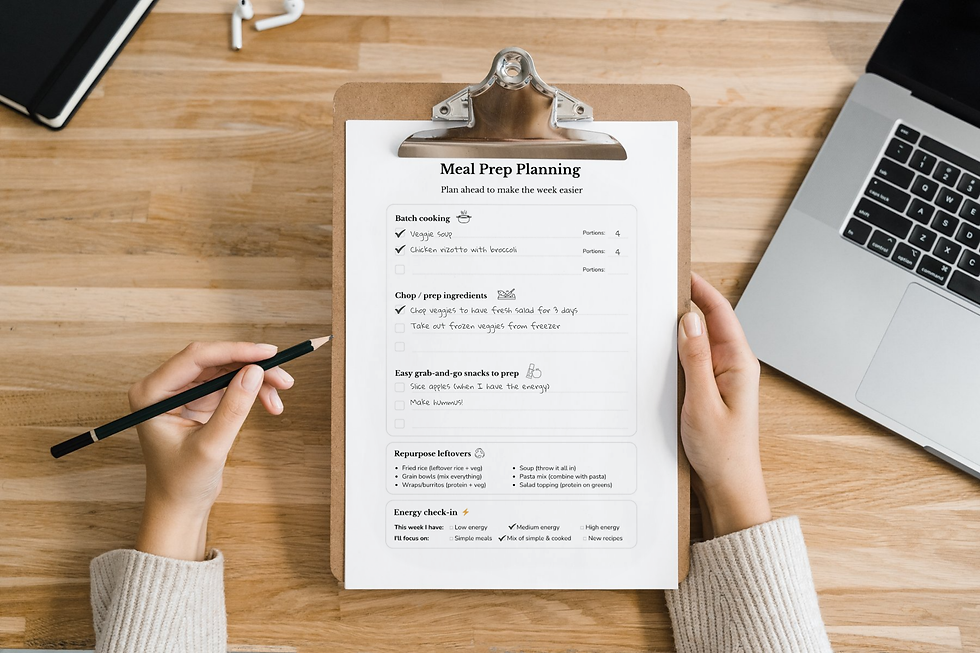
Decision Fatigue: Why It Hits Harder With ADHD (And What to Do About It)
Decision fatigue is a well-documented cognitive phenomenon: the more decisions you make throughout a day, the less capacity you have for making good ones as the day continues. This affects everyone — but it tends to be more pronounced for ADHD and autistic people.
ADHD involves reduced working memory and executive function, which means each decision uses more cognitive resources and those resources deplete faster than average. By evening — precisely when most people are making their most important food decisions — the tank is often critically low.
For autistic people, the social and sensory processing demands of navigating a neurotypical world use up significant energy that neurotypical people don't spend in the same way. By the time you're standing in your kitchen trying to decide what to eat, you may have already burned through considerably more cognitive fuel than most people do in a full day.
This is why "just decide what to eat when you're hungry" so reliably results in not eating, eating something unsatisfying, or ordering delivery again and feeling vaguely bad about it. It's not a discipline problem. It's a resource problem. And meal planning — when it's designed for your brain — is a resource conservation strategy, not a productivity exercise.
How to Actually Start Without Overwhelming Yourself
If previous attempts have burned you out, here's a lower-friction starting point:
Start with dinners only.
Breakfast and lunch can stay more routine or flexible. Dinner is usually the decision that causes the most friction, so start there.
Write down what you already eat.
Not aspirationally — actually. What meals do you currently make and eat? These are your starting point. They're already within your capability. Build your first rotation from these, not from new recipes.
Categorise by effort.
For each meal you eat regularly, roughly note how much capacity it requires. Now you have a ready-made library you can pull from based on your actual energy each day — rather than what you planned five days ago.
Plan components, not complete meals.
Instead of "stir fry on Tuesday," plan "I have protein, veg, and a carb in the house." Then you can assemble them however feels right in the moment. Less precise, much more adaptable.
Treat the plan as a safety net, not a schedule.
The plan is there so that when your brain opens at 6pm and is completely empty, you have something to reach for. It is not there to dictate. That shift in framing — from obligation to resource — often makes the whole difference.
A Note on Tracking Tools
If you've ever been curious about your own patterns — not to hit targets, but just to notice — Cronometer is one of the few apps I'd actually recommend to an ADHD brain.
It lets you log what you eat and spot trends over time, without the diet-culture noise of most tracking apps. You can use it to check in on nutrient gaps (magnesium, iron, B vitamins — all common in neurodivergent adults) without it becoming a rules-based system.
That said: only use it if it feels genuinely useful to you. Tracking can be a helpful tool or an unhelpful one depending on your relationship with food — and you're the one who knows which it is.

This post contains affiliate links. If you purchase through my link, I may earn a small commission at no extra cost to you.
The Neurola Weekly Meal Planner
The Neurola Weekly Meal Planner was designed around everything above. It's a flexible, low-pressure planning tool built specifically for ADHD and autistic brains.
It gives you space to:
Plan loosely across the week with room to deviate
Note your effort-level options for different types of days
Track what you have versus what you need without an elaborate system
Keep one central reference instead of trying to hold it all in your head
No calorie tracking. No dietary goals. No "variety" pressure. Just a clean, minimal layout that helps you reduce friction around food — on the terms your brain actually works on.
Available in A4 and US Letter formats. Digital download, instant access, print as many times as you need.

Currently on sale — instant digital download.
FAQ
Why can't I stick to a meal plan with ADHD? Standard meal plans assume consistent energy, predictable appetite, and a reliable path from planning to execution — none of which reliably describe ADHD brains. The plan isn't failing because of your discipline but because it wasn't designed for how your brain actually works.
What is the best meal planning approach for ADHD adults? The most effective ADHD meal planning approach involves: planning loosely (not rigidly), categorising meals by effort level, repeating meals that work without shame, planning 2–3 days ahead rather than a full week, and treating the plan as a flexible safety net rather than a contract.
Is it okay to eat the same meals every week with ADHD? Absolutely. Routine and repetition reduce decision fatigue and keep safe, familiar foods accessible. Meal variety is valuable over time but is not required for every week — especially if consistency helps you actually eat rather than getting overwhelmed by choices.
How do I meal plan when I have no energy? When energy is very low, even meal planning may not be possible. This is why it's important to plan during a higher-capacity moment, creating a ready-made reference for your lower-capacity moments. The goal is to do the decision-making work in advance so that future-you doesn't have to.
What is executive dysfunction and how does it affect eating? Executive dysfunction refers to difficulty with the cognitive processes that regulate goal-directed behaviour — including planning, initiating tasks, maintaining sequences, and managing transitions. In the context of eating, this can make it hard to decide what to cook, start cooking, follow a sequence of steps, and transition between tasks even when you're hungry and technically have the ability to cook.
Neurola makes ND-friendly content and tools for ADHD, autistic, and AuDHD adults — built by a neurodivergent dietitian who needed them herself. No diet culture. No hustle. No "fix yourself" framing.


Comments